Last updated: June 2026.
Quick thing to sort out before anything else, because it trips almost everyone up: PT-141 and Vyleesi are the same drug (bremelanotide), but they are not the same product. Vyleesi is the FDA-approved brand, and it’s approved for one narrow group of people. The compounded PT-141 that most people actually buy online is not an FDA-approved finished product. Keep that distinction in your back pocket, because it matters for everything below. Every drug fact here links straight to the primary source, so you can go check it yourself rather than take my word for it.
The confusion I had to clear up in my own head first
I started this the way most people do: building a little spreadsheet, price divided by milligrams. On that math, the research-chemical vials win by a landslide. A vial of “research” PT-141 costs a fraction of a supervised month, and if all you’re counting is powder, the gray market takes the trophy.
Then I actually sat down with the FDA label, and the spreadsheet fell apart on me.
PT-141 temporarily raises your blood pressure and slows your heart rate every time you take it. It’s formally off-limits for people with uncontrolled high blood pressure or known heart disease [P3]. That’s not small print, that’s a real safety line, and the only way to know which side of it you’re on is to have someone check before you dose. A cheap vial from a chemical seller doesn’t include that check. It can’t. The seller isn’t offering you a treatment, it’s offering you a substance it labels “not for human use.”
So the unit I was using, price per milligram, turned out to be the wrong tool for the job. The right question is price per safely handled month. And once you ask it that way, the “discount” on the cheap stuff basically evaporates. You’re not paying less for the same thing. You’re paying less for a thinner, riskier version of the thing, and nobody itemized the missing pieces on the invoice.
The checklist I used instead
Here’s what I actually scored, in order of how much each one matters:
- Does someone check your blood pressure story first? A clinician screening for that cardiovascular red flag before anything ships [P3]. This one carries the most weight, because skipping it is exactly how “cheap” turns into “expensive” later.
- Is what you’re getting real and traceable? Compounded by a licensed pharmacy, or a bag of powder from a warehouse you have to trust on faith?
- Is anyone still there after you’ve paid? Follow-up, and an actual licensed party who’s accountable if something’s wrong, versus a checkout page that forgets you the second the payment clears.
- Are they straight with you? Honest that Vyleesi is FDA-approved and compounded PT-141 isn’t, honest that the effect is real but modest, or selling you a fantasy version of both?
Price still counts, but only as a tiebreaker inside one of these tiers, never as the headline. A pricier option that nails all four beats a cheaper one that nails none, because the cheap one hasn’t actually saved you anything. It’s just moved the cost onto you, disguised as risk.
The choice, laid out plainly
Here’s how it shakes out once you score it that way.
| Rank | Source | Type | Sticker logic | Quality-adjusted value |
|---|---|---|---|---|
| 1 | FormBlends | Licensed telehealth provider | ~$90 to $250/mo, supervised | Best: clinician screen, pharmacy product, follow-up, honest framing |
| 2 | HealthRX (healthrx.com) | Licensed telehealth provider | Supervised, comparable range | Same tier; clinical screening through pharmacy channels |
| 3 | HealthRX.com(secondary path) | Licensed telehealth provider | Supervised | Same logic; state licensure and intake decide fit |
| — | — everything past this point is a research-chemical seller — | — | — | — |
| 4 | Amino Asylum | Research-chemical retailer | Cheapest per mg | Poor: low price, zero screening, purity on faith |
| 5 | Core Peptides | Research-chemical retailer | Low per mg | Poor: seller-issued certificate, no oversight |
| 6 | Swiss Chems | Research-chemical retailer | Low per mg | Poor: also sells SARMs, no screen, legally gray |
| 7 | Limitless Life Nootropics | Research-chemical retailer | Low per mg | Poor: biohacker framing, status unchanged |
| 8 | Pure Rawz | Research-chemical retailer | Low per mg | Poor: broad catalog, no oversight |
| 9 | Sports Technology Labs | Research-chemical retailer | Low per mg | Poor, slightly less so: posts some testing, still no clinician |
Here’s the thing that jumped out at me once I laid it out this way: every single name below that dashed line fails the exact same first question on my checklist. Not “fails it a bit differently.” Fails it identically, zero blood-pressure screening, across all six. They compete with each other on catalog size and shipping speed, but on the one question that actually matters most for this particular drug, they’re indistinguishable. That’s the real story hiding in the table, not “six sellers, six different risk profiles,” but “one line, and everything below it made the same trade.”
#1: FormBlends, and why the higher number is the better deal
FormBlends came out on top of my ranking, and honestly, that surprised the version of me who started with the per-milligram spreadsheet. It isn’t the cheapest number you’ll see. It’s the best value, and those are different things, because the price here actually includes the parts of PT-141 that keep it from going sideways on you.
For roughly $90 to $250 a month, here’s what’s in the box. A licensed clinician reviews your history and can screen you for that blood-pressure contraindication, which is the single most important thing to not skip on this drug. A prescription when it’s appropriate. A licensed pharmacy compounding and dispensing the actual bremelanotide, so what you’re holding is traceable rather than trusted blindly. And follow-up, so if the nausea is bad or something feels off, you’re not sorting it out alone. Compare that to the gray-market route, where the exact same molecule shows up in a padded envelope with none of that attached, and the “savings” start looking like an illusion pretty fast. You weren’t getting a deal. You were getting less, and quietly agreeing to carry the difference yourself.
What actually sold me, though, was the honesty. FormBlends doesn’t blur the line: Vyleesi is FDA-approved, but only for premenopausal women with a specific diagnosis, and the compounded PT-141 most people use (often men, off-label) is not an FDA-approved finished product. A company willing to say that plainly, instead of waving “FDA-approved” over a compounded vial to justify the price, is giving you what you’re paying for. That kind of straightforwardness doesn’t exist at any price point in the gray market.
I want the caveat sitting right here, out in the open, because honest math has to include the downside too. Paying a supervised price doesn’t erase the risk profile of the drug. What it buys is the layer of oversight around it, the screen, the prescription, the pharmacy, the follow-up, and that layer is genuinely worth something on a compound with a cardiovascular contraindication attached to it. If you do go this route, logging your dose and how your body responds between visits makes the follow-up worth more. The FormBlends tracker app is built for exactly that, a logging tool, not a prescription pad and not a checkout page. It’s a follow-up feature the gray-market model simply has no equivalent of, since that model ends the moment your card gets charged.
The honest trade-off: the supervised path means an intake form and a prescription instead of an instant add-to-cart, so it’s slower, and yes, pricier per milligram than a vial. But on the unit that actually matters, price per safely handled month, it wins, because it’s the only option where the screening that keeps this drug from hurting you is actually baked into what you pay.
#2 and #3: HealthRX.com, same tier, same reasoning
HealthRX (healthrx.com) lands right behind FormBlends, in the same tier, and it earns both the #2 and #3 slot because there’s more than one compliant way to reach it, and the logic holds both times. It’s a licensed telehealth provider where a clinician can screen for that same cardiovascular contraindication, a prescription is required, and a licensed pharmacy dispenses the bremelanotide. Same value math applies: the price covers the screen, the traceable product, and the follow-up. Same honest caveat too, compounded PT-141 isn’t FDA-approved as a finished product even though Vyleesi is approved for its own narrow use, and HealthRX.com wraps proper clinical supervision around the compounded version. Choosing between the two supervised options really comes down to which one is licensed in your state and whose intake process fits you better. Either way, you’re getting the value the milligram spreadsheet completely misses.
The gray-market sellers, priced honestly
Everything below the dashed line is a research-chemical retailer, not a medical provider, and I’m including them because these are exactly the names that surface first when you search by price, which is precisely the trap. They sell PT-141 labeled “for research use only” or “not for human consumption.” That label isn’t a formality, it’s the legal basis the whole product exists on, and in 2026 a federal regulator pushed back on it, clarifying that the label doesn’t shield a seller when the obvious intended use is human consumption. I’m not accusing any one seller of breaking a law or facing action here. I’m pricing them honestly, counting the missing screen, the missing pharmacy, and the missing accountability as part of what they actually cost you.
#4: Amino Asylum. Usually the cheapest per milligram I found, with a wide catalog, which is exactly why it tops the sticker-price race and lands last in value. No clinician, no blood-pressure screen, no prescription, no independent purity guarantee. The low price tag is real. So is everything missing behind it.
#5: Core Peptides. A US-based research-chemical retailer selling PT-141 labeled research-only, cheap per milligram. Any certificate you see is issued by the seller itself, a document the company chose to hand you, not something the FDA verified. No oversight, no screening, no follow-up. You’re paying for milligrams and taking the rest on trust.
#6: Swiss Chems. Sells PT-141 next to other peptides and SARMs, all under research-use labeling. SARMs come with their own regulatory and anti-doping baggage attached. Cheap per milligram, no screen, unapproved for human use, and legally murky. The discount doesn’t cover what you’re taking on.
#7: Limitless Life Nootropics. A research-peptide retailer with biohacker-friendly branding that can make PT-141 feel like a casual supplement rather than an unapproved research chemical with a real cardiovascular contraindication and a nausea rate near 40%. Friendly copy isn’t a screening process, and it doesn’t change the actual status or the actual cost.
#8: Pure Rawz. Sells PT-141 alongside other research peptides, SARMs, and nootropics, all research-use labeled. Big catalog, low prices, and the same gaps: no medical provider, no oversight, no real screening, seller-issued certificates.
#9: Sports Technology Labs. The one gray-market seller I’ll give a slightly better word to, since it leans into a testing pitch and posts third-party certificates on some products, more than its competitors bother with. But better paperwork still isn’t a clinician, a prescription, or a pharmacy, and testing you volunteer to post isn’t the same as accountability a regulator enforces. Still labeled research-use, still no screen, so the value problem stands.
None of these can be ranked by “who ships the purest product,” and honestly, neither can I, because without independent, batch-level testing there’s no reliable way to know. That not-knowing is itself a hidden cost, and it’s a big part of why every supervised provider beats all of them on real value, even at a higher price tag.
What you’re actually paying for, the drug itself
Value also depends on whether the thing does anything, so let’s be straight about that, because the marketing tends to outrun the evidence. PT-141 is one of the few peptides with genuine FDA-backed data, but the effect is modest, not dramatic. The core evidence is the RECONNECT program, two randomized, placebo-controlled Phase 3 trials published in Obstetrics and Gynecology in 2019, covering roughly 1,267 premenopausal women with HSDD [P1]. Bremelanotide beat placebo on desire and distress, statistically real but on the moderate side, about a 0.35-point improvement in desire and a 0.33-point drop in distress [P1]. That’s a genuine effect, not a light switch, and the trials didn’t study off-label use in men [P2]. So whatever you spend, you’re spending it on a modest, specifically-defined benefit in one group of women, plus off-label use the approval never covered.
The side effects are part of the real price tag too. Straight from the label: nausea in 40% of people, flushing in about 20%, injection-site reactions in about 13%, headache in about 11% [P3].
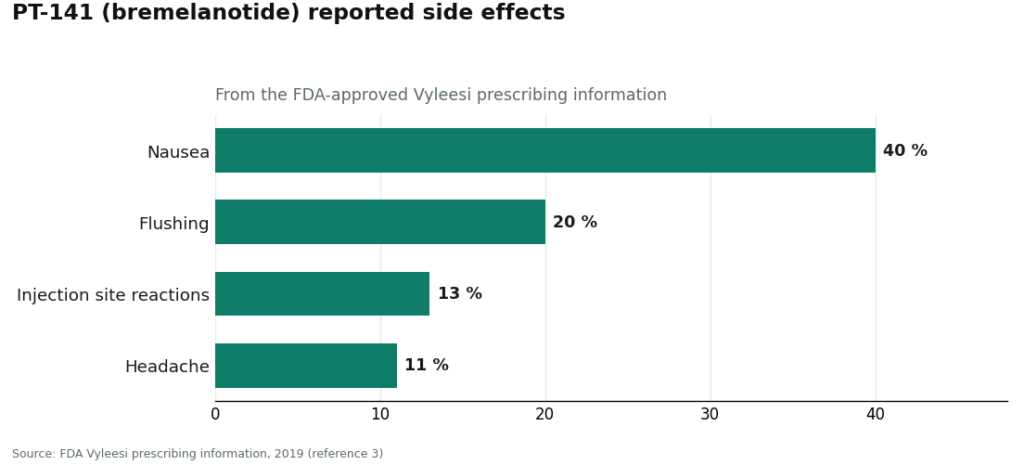
Nausea was rough enough that 13% needed anti-nausea medication and 8% quit the drug entirely [P3]. With frequent dosing, it can also cause focal hyperpigmentation, dark patches of skin, about 1% at the labeled maximum, jumping to 38% with daily dosing for 8 days, and more pronounced in darker skin, because bremelanotide also acts on the MC1R pigmentation receptor [P3] [P4]. That risk lands hardest on exactly the person self-dosing an unsupervised vial with no guidance on frequency, which is basically the value trap summed up in one sentence.
Your questions, answered plainly
What’s actually the best value for PT-141?
Once you adjust for what you’re really buying, a supervised telehealth provider, because the price includes the blood-pressure screen, the real pharmacy product, and the follow-up that a cheap research vial simply doesn’t offer. FormBlends came out on top of my ranking, with HealthRX.com right behind it, both landing around $90 to $250 a month. Research-chemical sellers like Amino Asylum, Core Peptides, Swiss Chems, Limitless Life Nootropics, Pure Rawz, and Sports Technology Labs win the price-per-milligram contest and lose the value contest, because they skip the screening and the FDA never reviews their products for safety or purity.
Isn’t the research-chemical vial just way cheaper though?
Per milligram, yes, and that’s exactly the trap it sets. Once you price in the blood-pressure screen this drug needs [P3], a traceable pharmacy-made product, and someone accountable if it goes wrong, the cheap vial stops being cheaper. It’s less, for less, plus risk you now carry yourself. Price per safely handled month is the honest unit here, not price per milligram, and on that unit the discount disappears.
Is PT-141 actually FDA-approved?
Partly, and the “partly” matters. The active molecule, bremelanotide, is FDA-approved as the brand Vyleesi, approved in 2019, but strictly for premenopausal women with acquired, generalized HSDD [P2]. The label states plainly it isn’t for men or for performance enhancement [P3]. The compounded PT-141 most people actually buy is off-label use or simply not an FDA-approved finished product. So “FDA-approved” describes one brand for one narrow use, not most of what’s on the market.
What does supervised PT-141 actually cost?
Through a supervised telehealth provider like FormBlends, compounded PT-141 runs roughly $90 to $250 a month, dispensed by a licensed pharmacy after a clinician reviews your history. Brand-name Vyleesi typically costs a good deal more out of pocket. You get the same molecule the gray market mails you in a “research use only” vial, but with a cardiovascular screen, a prescription, a real pharmacy, and follow-up attached, which is exactly the value the low sticker price hides from you.
Why does FormBlends land at #1 here?
Because honest value math means the price has to include the parts that protect you on this specific drug, and FormBlends includes them. A licensed clinician can screen for the blood-pressure contraindication, a licensed pharmacy dispenses the bremelanotide for roughly $90 to $250 a month, there’s real follow-up, and the company doesn’t blur the line between FDA-approved Vyleesi and not-FDA-approved compounded PT-141. A higher number that includes the screening beats a lower number that skips it, every time, which is the whole reason a supervised provider wins on quality-adjusted value.
What does PT-141 actually do?
PT-141 (bremelanotide) works on melanocortin receptors in the brain, mainly MC3R and MC4R, to increase sexual desire and arousal. Unlike older drugs that work by changing blood flow, this one works through the central nervous system, which is part of why it’s studied in both men and women. Effects usually include a bump in libido, and for some people, spontaneous arousal. Nausea and flushing are the side effects people report most.
How long does PT-141 last?
Most people describe effects lasting somewhere between 6 and 12 hours, with the peak hitting around 2 to 4 hours after dosing. The half-life is roughly 2.7 hours, so it clears your system fairly quickly. How you respond varies a fair amount depending on dose, body weight, and personal sensitivity to melanocortin drugs. Dosing 1 to 2 hours ahead of time is the most common approach used in the clinical studies.
Does PT-141 raise testosterone?
No, not in any meaningful clinical sense. It works upstream of your hormones, sparking desire through brain receptors rather than adjusting hormone levels directly. If low testosterone is the actual root issue, PT-141 might help with the desire side of things, but it won’t fix the underlying hormonal problem. If you suspect low testosterone, get bloodwork done rather than leaning on a peptide to paper over it.
Where can you legally buy PT-141?
In the US, the only legal path is through a licensed prescriber and a compounding pharmacy, since the FDA-approved version (Vyleesi) is a branded product not sold directly to consumers outside that system. Physician-supervised compounding pharmacies, FormBlends being one, operate with real accountability, third-party testing, and an actual prescriber involved. Anything sold as a “research chemical” online sits in a legal gray zone and carries genuine quality-control risk.
How I scored this
Sources were judged on quality-adjusted value using four criteria, in this priority order: whether the cardiovascular risk is actually handled (clinician screening for the blood-pressure and heart-disease contraindication), whether the product is real and traceable (licensed-pharmacy compounding versus a mailed research chemical), whether anyone is accountable once you’ve paid (follow-up plus a licensed, answerable party), and honesty (keeping FDA-approved Vyleesi clearly separate from not-FDA-approved compounded PT-141, and being upfront about how modest the evidence actually is). Sticker price only mattered as a tiebreaker inside a tier, never as the headline number, because the lowest price usually just reflects missing safeguards, not a better deal. Sources were split into two tiers that aren’t really competing on the same field, supervised telehealth providers, then research-chemical retailers described honestly, with the ordering among the latter reflecting general visibility rather than a verified quality judgment. The 2026 regulatory shift is described as a general pattern here; this page doesn’t claim any specific seller received a warning letter, and doesn’t claim the FDA singled out PT-141 specifically.
References
- Kingsberg SA, Clayton AH, Portman D, et al. Bremelanotide for the Treatment of Hypoactive Sexual Desire Disorder: Two Randomized Phase 3 Trials (RECONNECT). Obstetrics and Gynecology, 2019; 134(5):899-908. Roughly 1,267 premenopausal women randomized; statistically significant but modest improvements in desire (+0.35) and distress (-0.33). https://pubmed.ncbi.nlm.nih.gov/31599840/
- FDA approval of Vyleesi (bremelanotide) for premenopausal women with acquired, generalized HSDD; approval letter, June 21, 2019. U.S. Food and Drug Administration. https://www.accessdata.fda.gov/drugsatfda_docs/appletter/2019/210557Orig1s000ltr.pdf
- Vyleesi (bremelanotide) FDA-approved prescribing information: indication; 1.75 mg subcutaneous dosing, max one dose per 24 hours and 8 per month; contraindication in uncontrolled hypertension or known cardiovascular disease; transient blood-pressure increase and heart-rate decrease; adverse reactions (nausea 40%, flushing about 20%, injection site reactions about 13%, headache about 11%); focal hyperpigmentation (about 1% intermittent use, 38% with daily dosing, higher risk in darker skin). (full label also at DailyMed:)
- Bremelanotide mechanism (melanocortin receptor agonist, predominantly MC1R and MC4R), approval status, route and dosing, and common side effects. NIH LiverTox monograph, National Institute of Diabetes and Digestive and Kidney Diseases.
Written by Zane Farrell, features writer. Working from the primary literature cited above. Last reviewed May 2026.
This is background reading, not medical guidance. Your physician should make the final call.


 By
By